


2. Environmental information
This section covers the effects, risks, opportunities, governance, strategies, actions, and results of Deloitte's identified material environmental impacts, risks and opportunities.
In line with the ESRS, we will describe the processes to identify and assess material impacts, risks and opportunities for the environmental sustainability matters not in scope of our reporting due to a lack of materiality.
Table 04: materiality processes and considerations with regard to non-material environmental sustainability matters
|
ESRS |
Topic |
Processes and considerations |
|
E2 |
Pollution |
Offices screened for possible use of pollutants in cleaning processes |
|
E3 |
Water and marine resources |
Water consumption in offices is measured on a monthly basis |
|
E4 |
Biodiversity and ecosystem |
We have identified and assessed actual and potential impacts on biodiversity and ecosystems at own site locations and in the upstream and downstream value chain, using social impact calculations and spend analysis for upstream activities as well as an impact study we performed in 2022 on biodiversity and nature. Our assumption is that there is no causal or material effect of our downstream activities (audit and business advisory) that affect biodiversity and ecosystems |
|
E5 |
Resource use and circular economy |
Waste generation in offices is measured on a monthly basis |
2.1 Climate and CO2
Key results

Material impacts, risks and opportunities
As our organisation grows, so does our responsibility and opportunity to drive positive environmental change. We burn fuels to heat our buildings, purchase electricity to power our buildings and charge our cars, and we buy airline or railway tickets to travel to international clients. We also have suppliers who emit CO2 to produce and transport their goods or render their services to us. We fully recognise and understand that our operations have a negative environmental impact. We are dedicated to minimising this impact and have established a clear strategy towards achieving this.
In our Double Materiality Assessment as included on pages 93-98, we have identified the following material IROs for Climate and CO2:
-
Risk that extreme weather events can impact infrastructure (e.g., data and delivery centres) and employee productivity, thus putting business operations and service delivery at risk
-
Risk that clients in sectors that are highly exposed to climate change and/or that are unable to transition can potentially result in decrease in revenues for Deloitte
-
Impact (positive and negative) of our business activities on GHG emissions throughout our value chain
-
Opportunity to increase revenue growth by expanding climate-related services to support clients in their response to climate change
-
Reputational risk of association with clients perceived as having an inadequate response to climate change or inadequate climate credentials
-
Risk and opportunity that meeting clients' and other stakeholders' expectations on climate impact management can impact reputation and revenues
Climate risk
In December 2025, Deloitte NSE published their report describing the climate-related financial disclosures for NSE and its geographies. It contains a comprehensive overview of our global climate ambitions, impacts and the risks that apply to our business. Our assessment of financial risks and opportunities in determining materiality is informed by this publication.
NSE climate risk process
Deloitte employs a comprehensive Enterprise Risk Framework (ERF) to identify, assess, manage, and monitor risks at both the NSE and local national practice levels. This framework outlines the NSE Executive’s evaluation of key and emerging risks that could affect the firm's strategic objectives, public obligations, and reputation.
Climate change and sustainability concerns are integral to the ERF, with risks categorised by their likelihood and potential impact. These risks are assessed across four dimensions: strategic differentiation, brand reputation, operational resilience, and workforce purpose. Significant climate-related risks include regulatory changes and shifting client needs, which are analysed using qualitative scenario assessments.
The Enterprise Risk and Monitoring (ERM) Team oversees the ERF, assigning Executive Risk Owners to manage climate-related risks actively. Regular meetings between the ERM team and these owners focus on risk management effectiveness, mitigation strategies, and necessary actions. The ERM team maintains a risk dashboard for ongoing assessment and validation of risks, with a mandatory review every six months involving the NSE Chief Risk Officer (CRO).
Executive Risk Owners present their assessments of climate risks to the NSE Executive, which are then reviewed by the NSE Audit and Risk Committee (ARC). The Climate Steering Committee ensures accountability for managing climate-related risks, evaluates outcomes, and provides a comprehensive overview of climate impacts to the NSE Executive, solidifying the integration of climate risk management into Deloitte's broader risk management processes.
Time Horizons
For the purpose of defining climate-related risks and opportunities, Deloitte maintains time-horizons that deviate from the definitions provided in section 1.1 of this Annex:
-
Short-term (up to 2027) is aligned with Deloitte’s internal planning and forecasting time
frames; -
Medium-term (2027-2030) is in line with the firm’s near-term 2030 goals;
-
Long-term (2030-2050) is defined through to 2050 in line with UK and EU jurisdictional net-zero targets.
Climate Scenarios
Deloitte NSE has selected the Network for Greening the Financial System (NGFS) Climate Scenarios for use in its scenario analysis. Deloitte NSE is a professional services organisation with diverse geographic and sectoral exposure similar to that experienced in the financial services sector. On this basis, we consider the NGFS scenarios to be most suitable to understand how Deloitte NSE’s climate and risk exposure and resilience could evolve in the future, as a result of different climate change trends.
Deloitte selected three scenarios – Current Policies (3°C), Divergent Net Zero and Orderly Net Zero by 2050 – to assess the impacts of climate-related risks and opportunities across the applicable short, medium, and long-term time horizons. The use of two net-zero scenarios with similar policy ambitions (below 1.5°C) but different policy reactions enables a range of risks and opportunities to be captured in a transition scenario, factoring in the market and regulatory drivers to which Deloitte NSE is most exposed. This is particularly relevant given the comparable climate policies and net-zero ambitions of the UK and EU, and the relative financial importance of these markets to Deloitte NSE’s overall revenue. The Current Policies scenario represents a significantly warmer future where physical climate impacts could put business operations and continuity at risk.
Analysis performed in 2023 used the firm’s internal scenario modelling to assess each climate scenario’s potential positive and negative implications. The selected scenarios enable Deloitte to robustly assess the impacts of climate change over the short, medium, and long-term under three possible pathways, with global warming ranging from 1.5°C to 3°C. As there have been no material changes to the firm in 2025/2026, the results of the analysis are still valid. The firm recognises that under CFD requirements it is expected to review and refresh its scenario analysis at least every three years. This will next be undertaken for the 2026/2027 disclosures.
Process for defining climate-related risks and opportunities
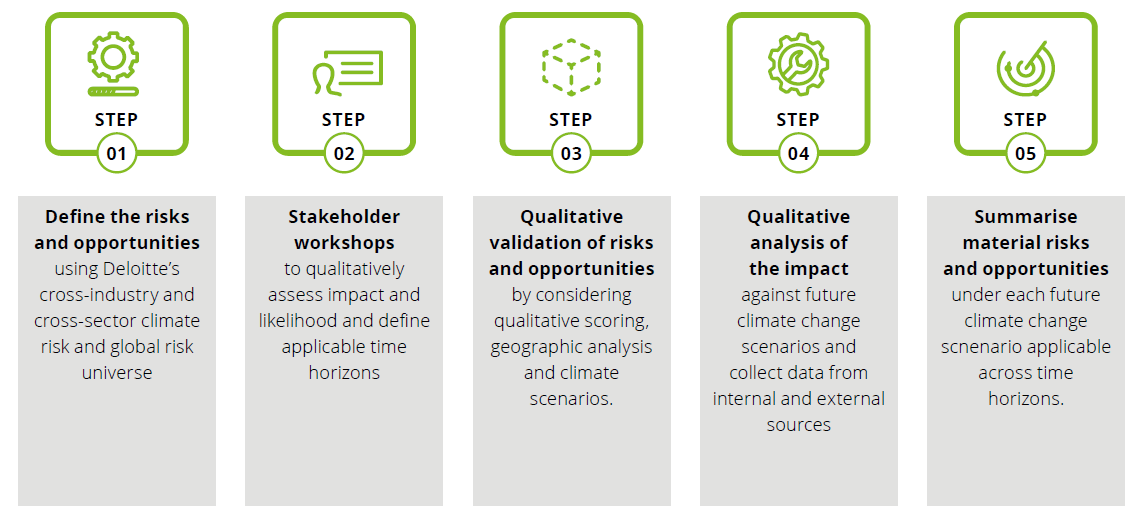
The climate-related risks and opportunities assessment used the same likelihood and impact risk criteria as the firm’s Enterprise Risk Framework (ERF), which is described in the Risk management section above.
The identified climate-related risks and opportunities were assessed by members of the Climate SteerCo (as well as other key senior stakeholders across Deloitte NSE) by scoring the likelihood and impact for each risk and opportunity. Together with qualitative analysis based on market data, an average combined score was then calculated for each risk and opportunity to understand the significance to Deloitte. Following consideration and approval by the Climate SteerCo, the climate-related risks and opportunities that were determined to have a potential impact on the business have been disclosed below.
Two types of climate-related risks and opportunities have been determined as having a potential impact: physical (acute and chronic) and transition (market, reputation, policy and legal). Further analysis has been performed for these, including impact assessments and scenario modelling (against the three scenarios identified above) and corresponding strategic responses. The results are presented in table 05 below.
Table 05: Material climate-related risks and opportunities
|
Risk: Physical - Acute and Chronic |
|
|
Description and potential impact to Deloitte |
|
|
Potential impact under climate scenarios and time horizons |
Strategic response and resilience |
|
Risk: Transition (market) |
|
|
We recognise that we will be impacted in some way by the policy, market and technological changes brought by a transition towards a low-carbon economy. The precise nature and scale of the impact |
|
|
Potential impact under climate scenarios and time horizons |
Strategic response and resilience |
|
Opportunity: Transition (market) |
|
|
As a global business with a breadth of skills, resources and experience developed through its long-standing relationships with companies across multiple industries, this presents an opportunity to grow |
|
|
Potential impact under climate scenarios and time horizons |
Strategic response and resilience |
|
Risk and opportunity: Transition (reputation) |
|
|
People are central to Deloitte’s services and operations. The Deloitte Global 2025 Gen Z and Millennial Survey shows over 70% of Gen Z and millennials consider an employer’s environmental credentials important. |
|
|
Potential impact under climate scenarios and time horizons |
Strategic response and resilience |
|
Risk: Transition (reputation) |
|
|
Deloitte’s reputation and public trust are central to our ability to act in the public interest and to win and maintain client and stakeholder relationships. If the firm is seen to have inadequately tackled climate change across its operations and value chain, public confidence could fall and clients may reduce or cease engagement, with negative effects on revenue and growth. Increasingly, clients expect suppliers to meet minimum climate standards — including net‑zero targets — and these requirements are likely to become stricter; failure to demonstrate appropriate credentials could therefore result in lost contracts and income. |
|
|
Potential impact under climate scenarios and time horizons |
Strategic response and resilience |
|
Risk: Transition (reputation) |
|
|
Deloitte’s brand and reputation are driven in part by the clients we serve. As such, providing services to (or being associated with) companies or sectors that are perceived as having unfavourable climate credentials or that are not willing to respond to climate, have not articulated a credible transition plan or are not transparent about their actions to address climate change, could damage Deloitte’s reputation. |
|
|
Potential impact under climate scenarios and time horizons |
Strategic response and resilience |
|
Risk: Transition (policy and legal) |
|
|
The demand for Deloitte’s services has increased, and is likely to continue increasing, as its clients consider climate-related impacts and respond to related legislation. Should the firm fail to meet expected quality standards, it could face an increase in the frequency and severity of climate-related litigation and/or accusations of greenwashing. This could increase costs incurred by Deloitte and lead to reputational damage. |
|
|
Potential impact under climate scenarios and time horizons |
Strategic response and resilience |
As detailed in the ‘Strategic response and resilience’ column in the table above, Deloitte is resilient to the climate-related risks identified and is taking steps to further increase resilience. In the short term, the firm leverages strengths such as its diversified client portfolio and flexible working models. Medium-term strategies include actively monitoring market trends, investing in climate-related service offerings, and implementing the ‘Better Buildings’ framework for sustainable office spaces. Looking to the long term, Deloitte NSE focuses on achieving its sustainability strategy goals, embedding climate considerations into real estate decisions, and fostering a proactive climate-conscious culture to attract and retain talent.
Considerations and conclusions from Deloitte Netherlands
Deloitte NL operates as a company with a low investment in physical assets. According to the notes in the financial statements, sections 4.3 and 4.4, there is a clear differentiation between assets owned by Deloitte and those owned by others, which Deloitte has the right to use. The value of assets owned by Deloitte is €47.9 million, primarily comprising office furnishings and (portable) IT equipment. Similarly, mobile data devices such as laptops and mobile phones are not considered to be at material risk from climate change. Depreciation of office-related assets is in line with the duration of the specific office rental contracts, meaning that physical risks are mitigated to a level that we do not deem them to be material.
Assets owned by others mainly consist of rented office buildings and leased vehicles. Transition risks for vehicles are mitigated by our fleet's transition to electric vehicles. An uncertainty in this area is the installed capacity of the national grid in the Netherlands: in certain areas of the country there is already an overload of the electricity infrastructure. We do not perceive to have any material physical climate risks to our leased vehicles, partly because the maximum lease duration is set to five years. Regarding office spaces, we engage in temporary lease agreements, which afford a level of adaptability in our portfolio of offices should there be shifts in business conditions prompted by climate change. As a result of our approach, we do not regard transition or physical climate risks to assets owned by third parties as material.
As we do not have significant owned assets and we have flexibility in our leased ones, none of our assets are at material transition risk. In parallel, none of our assets are at material physical risk as a result of the climate change adaptation actions that we defined in the context of our Net-Zero Transition Plan (see pages 107-108).
In terms of revenue, we do not believe our revenue to be at risk due to physical climate risks in the short or medium term as our business is volatile and climate opportunities exceed climate risks. For the longer term, together with our EMEA partners, we will further investigate what our clients’ exposure is to physical climate risks and we will assess what the potential impact is on their business continuity.
Our climate related activities contribute to the following SDGs:

Objectives and ambition
Our environmental ambitions are anchored by both near-term and long-term targets, validated by the Science Based Targets initiative (SBTi). This validation confirms our net-zero goal is aligned with the Paris Agreement's objective to limit global warming to 1.5°C.
Our Netzero target: Deloitte commits to reach net-zero GHG emissions across the value chain by 2040.
Near-term targets:
-
Reduce absolute scope 1 and 2 GHG emissions 70% by 2030 from a 2019 base year;
-
Reduce scope 3 GHG emissions from business travel 55% per full-time equivalent employee (FTE) by 2030 from a 2019 base year;
-
Engage with our suppliers, covering purchased goods & services and business travel, to have 67% by emissions set science-based targets by 2025. As this target has expired, we are waiting for DTTL to set a new target in line with SBTi guidance.
Long-term target:
-
Reduce absolute scope 1, 2, and 3 GHG emissions 90% by 2040 from a 2019 base year.
For Deloitte Netherlands, we set additional goals, including achieving 100% renewable energy by 2030 and converting 100% of our vehicle fleet to electric by the end of 2025, which we fell short of fully achieving.
Governance
To embed climate actions across our organisation, we have set up a robust governance structure. Our dedicated Internal Sustainability Team translates our Transition plan into actionable steps for our operational functions, monitors progress, and reports directly to the Chief Quality & Risk Officer, who holds overall responsibility for sustainability. The team works with operational leads for real estate, travel, IT, and procurement to integrate sustainability into day-to-day decisions
Behavioural change is fundamental to our success. We aim to empower and enable individuals across the firm to make active contributions to our environmental and social goals. To support this, we facilitate two‑way communication at several key moments throughout the year, for example through roadshows in which we presented the sustainability strategy to each business and work together to define personal commitments. In April 2026, we celebrated Earth Month, conducting various activities to raise awareness and encourage colleague engagement.
Internationally, we participate in the Deloitte EMEA WorldClimate structure, collaborating to advance our CO2 reduction strategy and report progress to the EMEA Chief Sustainability Officer. We also draw on the Deloitte Global network for guidance on material topics and to align data definitions and methodologies. On a quarterly basis, we report progress to the EMEA team to support monitoring, identify challenges that require additional support, and collaborate across regions, benefiting from expertise in other countries.
Over the coming year, we will further formalise the integration of the net‑zero transition plan into our governance framework to enable effective steering and to provide leadership with regular updates on progress, challenges and critical decision points.
Finally, we believe working together and learning from each other supports the ongoing sustainability transition and challenges. Therefore we actively engage and learn from our peers. To this end, Deloitte is member of:
-
Green Business Clubs in Amsterdam and Rotterdam;
-
UNGC, including active participation in Peer Learning Groups for Climate, Human Rights and Diversity;
-
MVO Nederland;
-
Coalitie Anders Reizen.
Transition plan – The road to net-zero
Achieving our net-zero ambition requires a fundamental transformation of our business operations. Our global Net-Zero Transition Plan provides a strategic, firm-wide roadmap that addresses our most material emission sources: travel, buildings, procurement, and technology– with critical enablers including accountability and culture ensuring net-zero is embedded in our decisions and actions as the shape, size and focus of the firm evolves over time.
Our Transition plan is based on four decarbonization levers: travel, responsible procurement, technology and buildings.
Travel
Emissions from travel can be split into two categories: national mobility (how people commute from home to the office or to client sites) and international business travel. Travel is one of the largest contributors to our carbon footprint, so it is a primary focus of our Net-Zero Transition Plan. Through targeted actions, we promote more sustainable travel choices to help mitigate climate change.
We are proud of the progress made over the last year on employee mobility. Our company vehicle lease schemes now exclusively offer electric vehicles. We committed to phasing out fossil‑fueled cars and we fell two cars short of achieving 100% electric vehicles in our leased fleet in 2025/2026 - an important milestone on our path to net-zero. As a next step, we will work with the automotive sector to ensure that temporary rental cars are electric, recognising that fossil‑fueled vehicles may still be used when our EVs are in for repairs. We are also seeking greater transparency from suppliers about the sources of electricity that are used for charging, as relying on a national average emission factor does not allow for conscious choices on where to charge and where not.
As a professional services organisation, we recognise the value of meeting our clients and colleagues face‑to‑face. At the same time, we strive to travel in a balanced way and to consider sustainability when making travel choices. Our business travel policy encourages people to travel only when necessary, to opt for virtual or hybrid meetings where appropriate, and to use local staff when possible. For essential trips we prioritise modes and routes that minimise CO2 emissions and cost. In line with our reduction ambitions, we favour rail over flights for short‑haul international journeys and recommend travel classes that reduce carbon intensity: Economy or Premium Economy for intercontinental travel, and Economy for flights under six hours.
To maintain oversight, carbon budgets for business travel are agreed with business COOs. These budgets set an allowable amount of CO2 (in tonnes) attributable to business travel and reflect expected behavioural change and industry developments. Progress against the budgets is monitored quarterly and used to steer performance throughout the year in order for us to meet our preset targets.
Deloitte does not believe investments or disposals will be necessary as a result of managing material sustainability matters. Deloitte's strategy is sourced through our normal planning cycle: costs are absorbed in the current year P&L.
Responsible procurement
We recognise the environmental impact of the goods and services we buy and are working with suppliers to reduce demand and find more sustainable alternatives - for example, by products with enhanced longevity or with materials from responsible sources. Sustainability is being embedded across supplier selection, contracting and ongoing engagement.
This year, we have increasingly included sustainability criteria in the selection of our strategic suppliers. Suppliers are asked to provide sustainability information during tender processes, and this information is scored as part of the selection criteria.
The principles we apply are set out in our Responsible Procurement Policy (RPP), launched in 2025. The RPP has been referenced in our updated general purchasing conditions for new suppliers. Beyond embedding the policy in contracts, we proactively engage strategic suppliers to discuss the RPP, identify any gaps, and agree on necessary follow‑up actions.
We aim to ensure suppliers adhere to the RPP and to collaborate with them to accelerate the availability of more sustainable products and services. Together, we identify potential more sustainable alternatives for the goods and services we purchase.
Technology
Technology is a principal focus of our Net‑Zero Transition Plan because its emissions are significant and expected to rise. We aim to decouple our reliance on technology from rising greenhouse‑gas emissions through initiatives across 1) hardware, 2) cloud services, 3) software and applications, and 4) generative AI. Understanding these impacts and embedding sustainability into how we design, run and procure technology is essential.
-
Hardware | We aim to reduce unnecessary material consumption, right‑size our device estate, extend device longevity and prioritise refurbished or recycled‑content devices when procurement is required. For end‑user hardware, we have formalised repair and refurbishment partnerships, including with Fixje, to extend lifetime and support reuse, repair and responsible recycling.
-
Cloud services | we want to improve the efficiency of our data, applications, software and infrastructure — including cloud and third‑party infrastructure under our control — and where we can further optimise their operation.
-
Software and applications | we are embedding net‑zero expectations into our relationships with technology suppliers, building on our Responsible Procurement Policy.
-
Generative AI | Generative AI is an emerging area requiring focused attention. As adoption grows, so does the computational and energy demand it creates. We take this seriously and are actively improving our understanding so we can manage and reduce its environmental impact going forward.
Buildings
Our real estate strategy prioritises occupying energy‑efficient buildings and working with owners and stakeholders to make our offices “Paris Proof”, resilient and aligned with the temperature goals of the Paris Agreement. This requires substantial investment and close collaboration. Our Amsterdam office, The Edge, and our Rotterdam office, Maastoren, both have high energy‑performance ratings, including BREEAM certification.
Where we manage energy contracts directly, we partner with Groendus, an energy marketplace, to match our energy consumption with renewable sources. We also encourage landlords to adopt green energy for the buildings we occupy.
In line with our global Real Estate Policy, we are setting energy‑reduction targets and implementing further efficiency measures. This commitment extends to fit‑outs: we apply circular‑economy principles and work with suppliers to measure and reduce the environmental impact of renovation projects.
Current and future financial resources allocated to climate action are integrated in the budgets of the topic owners (e.g, Workplace Services for fleet and housing, IT for technology, and Procurement for supply chain. In addition, some activities are led by and paid for by EMEA.
|
Policies |
IROs addressed |
Actions |
Challenges |
Next-steps |
|
|---|---|---|---|---|---|
|
Travel |
Deloitte Travel policy |
1, 3, 6 |
Established and monitored annual carbon budgets for each business, with quarterly COO reviews to steer performance. A carbon emissions travel dashboard tracks key travel metrics continuously. |
We acknowledge that as a business we will continue important business travel. It is therefore important that alongside the ongoing focus on behaviour change, industry developments accelerate the decarbonization of the entire sector. |
Continue employee engagement on carbon budgets and sustainable travel choices. |
|
Supply Chain |
Responsible Procurement Policy |
1, 3, 6 |
Policy: roll-out of the responsible procurement policy. |
To be able to monitor and steer periodically, supplier specific data on the products and services that we purchase is needed. Therefore we will work together with suppliers to discuss more sustainable alternatives for the products and services we purchase and obtain supplier specific information when possible. |
Continue supplier engagement conversations with (strategic) suppliers to work towards more sustainable alternatives for the goods and services we purchase. |
|
Technology |
Firm-wide Net-Zero Transition Plan |
1, 3, 6 |
Strengthened our circular hardware practices by refurbishing all laptops from offboarding employees and partnering with certified vendors who use salvaged parts for repairs. |
Limited availability of granular emissions data from technology suppliers. |
Enhance technology emissions data to target and prioritise reduction initiatives. |
|
Buildings |
Global Real Estate Policy |
1, 3, 6 |
Applied a new sustainable fit-out approach with defined KPIs to our major renovation project in The Edge office. |
Driving energy reduction measures in multi-tenant buildings where progress depends on the collaboration of landlords and other tenants. |
Roll out the Global Real Estate Policy across all offices, with a focus on energy reduction and increasing green energy procurement. |
Certification
Our sustainability progress is recognised externally. This year we moved from Silver to Gold in our EcoVadis rating, a global sustainability‑ratings platform, placing us in the top 5% of companies in our industry (n=1,239). The EcoVadis scorecard is available to trading partners on request.
We also achieved the second step under the new standards of the CO₂ Performance Ladder certification scheme. The certificate and supporting documentation are available on our website.
(Beyond) value‑chain mitigation
While pursuing an absolute emissions reduction of at least 90% by 2040, Deloitte uses both carbon offsets and direct investments in Beyond Value Chain Mitigation (BVCM) projects to support climate mitigation on the path to net-zero. BVCM projects address emissions reductions beyond our direct operations and immediate supply chain, for example through large‑scale renewable energy, landscape restoration or avoided‑emissions activities.
For 2024/25, Deloitte NSE compensated CO2 emissions across all NSE geographies by investing in a range of certified carbon‑avoidance and renewable‑energy projects. We also acquired RE100‑compliant, EKOenergy‑certified renewable energy certificates (issued under the European Energy Certificate System, EECS) to green all non‑renewable electricity consumption, including the power used to charge our electric fleet.
Once total CO2 emissions for 2025/26 have been verified, NSE will again procure credits to compensate those emissions. In addition, we have also begun participating in BVCM projects across the EMEA region.
These compensation purchases and BVCM investments do not alter our reported emissions results figures.
Systemic challenges
Our greatest impact comes from the work we do with clients and through collaboration. We embed sustainability into client projects to accelerate transformations across industries, focusing our expertise on a number of complex, system‑level challenges:
-
Accelerating the energy transition | We help clients define credible paths to net‑zero and scale low‑carbon solutions. Our global centre of excellence for hydrogen plays a key role in supporting the move to cleaner energy systems;
-
Developing a sustainable food system | Through research and our Net Positive Network, we promote a food system that operates within planetary boundaries. Our work targets regenerative agriculture, reducing food waste, and the protein transition — shifting diets and supply chains towards lower‑impact protein sources;
-
Building a circular economy | We develop practical solutions to embed circularity in products and processes. For the third consecutive year we contributed to the global Circularity Gap Report, and we helped develop the Global Circularity Protocol for Business with the World Business Council for Sustainable Development and UNEP’s One Planet Network;
-
Enabling a nature‑positive society | We are committed to helping halt and reverse nature loss. Working with partners such as WWF‑Netherlands, we support the adoption of the Taskforce on Nature‑related Financial Disclosures (TNFD) framework across the financial sector.
These areas reflect where we can use our skills and relationships to drive large‑scale, lasting change.
We made the following considerations when determining which Scope 3 emissions are relevant to Deloitte:
Table 06: Considerations for inclusion Scope 3 emissions
|
Description |
Consideration |
Conclusion |
|
Purchased goods and services |
Is material on the basis of our spend |
Included |
|
- Optional sub-category: Cloud computing and data centre services Capital goods |
Is part of Purchased goods and services |
Excluded |
|
- Optional sub-category: Capital goods |
Deloitte is asset-light hence emissions are limited |
Included |
|
Fuel and energy-related activities |
Well-to-tank emissions as a result of fuel consumption in our fleet |
Included |
|
Upstream leased assets |
We rent our offices and are not in control in most of them for heat and power |
Included |
|
Waste generated in operations |
Included as we strive towards a zero-waste workplace |
Included |
|
Processing of sold products |
We do not process sold products |
Excluded |
|
Use of sold products |
We sell services and not products so not applicable |
Excluded |
|
End-of-life treatment of sold products |
We sell services and not products so not applicable |
Excluded |
|
Downstream leased assets |
We have no downstream leased assets |
Excluded |
|
Franchises |
We have no franchises |
Excluded |
|
Upstream transportation and distribution |
As we do not process or sell products, there is no upstream transportation and distribution |
Excluded |
|
Downstream transportation and distribution |
As we do not process or sell products, there is no downstream transportation and distribution |
Excluded |
|
Business travels |
Business travel is a significant part of our GHG emissions |
Included |
|
Employee commuting |
With over 7 thousand employees, employee commuting has the potential of being a significant source of GHG emissions |
Included |
|
Financial investments |
We do not have financial investments |
Excluded |
Table 07: Total Greenhouse Gas Emissions per scope*
|
Base year* |
Retrospective |
Milestones and target years |
|||||
|
2018/2019 |
2025/2026 |
2024/2025 |
Δ previous year (%) |
2030 |
2040 |
Annual % target |
|
|
Scope 1 GHG emissions |
|||||||
|
Gross Scope 1 GHG emissions (tCO2eq) |
14,511 |
1,598 |
3,793 |
-57.9% |
0 |
0 |
|
|
% of Scope 1 GHG emissions from regulated emission trading schemes (%) |
0 |
0 |
0 |
0.0% |
0 |
0 |
|
|
Scope 2 GHG emissions |
|||||||
|
Gross location-based Scope 2 GHG emissions (tCO2eq) |
2,153 |
3,466 |
4,010 |
-13.6% |
0 |
0 |
|
|
Gross market-based Scope 2 GHG emissions (tCO2eq) |
414 |
0 |
30 |
-100.0% |
0 |
0 |
|
|
Significant scope 3 GHG emissions |
|||||||
|
Total Gross indirect (Scope 3) GHG emissions (tCO2eq) |
33,933 |
8,252 |
11,916 |
-30.8% |
17,377 |
4,714 |
|
|
1. Purchased goods and services |
17,244 |
*** |
11,622** |
- |
10,346 |
2,587 |
|
|
3. Fuel and energy-related activities |
4,744 |
1,240 |
1,977 |
-37.3% |
1,680 |
0 |
|
|
5. Waste generated in operations |
N/A |
38 |
43 |
-11.7% |
39 |
35 |
|
|
6. Business traveling |
11,889 |
4,928 |
7,615 |
-35.3% |
3,567 |
1,783 |
|
|
7. Employee commuting |
N/A |
71 |
80 |
-11.1% |
1,543 |
309 |
|
|
- Working from home |
N/A |
1,859 |
1,937 |
-4.0% |
|||
|
8. Upstream leased assets |
55 |
116 |
264 |
-56.2% |
202 |
0 |
|
|
Total GHG emissions (location-based) (tCO2eq) |
50,596 |
13,315 |
31,341 |
-57.5% |
17,377 |
4,714 |
|
|
Total GHG emissions (market-based) (tCO2eq) |
48,858 |
9,850 |
27,361 |
-64.0% |
17,377 |
4,714 |
|
* We have selected 2018/2019 as our base year as this is the last year that was unaffected by the restrictions during the COVID pandemic and was therefore selected by DTTL as the base year for the WorldClimate strategy. We believe that 2018/2019 still is a valid year to measure progress against.
** We have recalculated and restated our prior period (2024/2025) PG&S emissions data. Since 2018/2019, we have made changes to our PG&S emissions reporting methodology following developments in best practice and improvements in data granularity and systems. As a result, we are unable to apply all changes retrospectively. This limits the comparability of reported emissions for 2024/2025 and 2025/2026 to the baseline year.
*** To a large extent, our emissions related to Purchased goods and services are calculated by DTTL and EMEA on the basis of relevant spend. Due to a change in the methodology, their conclusions for 2025/2026 were not available in time for inclusion in and review of the PDF of our report.
To determine Gross market-based Scope 2 GHG emissions, we have taken the RECs purchased by Deloitte NSE into account as these cover both electricity consumption for offices and for charging electric vehicles. With the reduction of cars with an internal combustion engine, we saw the related Scope 1 GHG emissions further reducing. Business travel emissions saw a decrease primarily as a result of lower emission factors as published by DEFRA.
Table 08: Greenhouse gas intensity*
|
2025/2026** |
2024/2025 |
2023/2024 |
Δ FY26 vs FY25** |
|
|
GHG intensity per net revenue |
||||
|
Total GHG emissions (location-based) per net revenue (tCO2eq/1,000 euro) |
0.009 |
0.020 |
0.017 |
-54.3% |
|
Total GHG emissions (market-based) per net revenue (tCO2eq/1,000 euro) |
0.007 |
0.017 |
0.017 |
-58.4% |
* Greenhouse gas intensity is calculated using 'Revenue' as included in the 'Consolidated statement of profit or loss and other comprehensive income for the year ended May 31, 2025, in Annex 1 of this report.
** The data for 2025/2026 excludes emissions due to Purchased goods & services
Table 09: Housing
|
2025/2026 |
2024/2025 |
|||
|
Scope 1 thermal energy consumption |
1,461 |
GJ |
1,672 |
GJ |
|
- from renewable sources |
0 |
GJ |
0 |
GJ |
|
Scope 2 energy consumption |
1,061,178 |
kWh |
2,163,998 |
kWh |
|
- renewable sources |
1,061,178 |
kWh |
1,782,667 |
kWh |
|
- nuclear sources |
0 |
kWh |
0 |
kWh |
|
- self generated |
0 |
kWh |
0 |
kWh |
|
- non-renewable sources or unknown |
0 |
kWh |
381,331 |
kWh |
|
Scope 3 energy consumption |
8,547,566 |
kWh |
10,789,690 |
kWh |
|
- renewable sources |
7,990,407 |
kWh |
9,672,882 |
kWh |
|
- non-renewable sources or unknown |
557,159 |
kWh |
1,116,808 |
kWh |
|
Specific electricity consumption |
92.59 |
kWh/m2 |
101.41 |
kWh/m2 |
|
Specific thermal energy consumption |
0.022 |
GJ/m2 |
0.136 |
GJ/m2 |
Table 10: Mobility
|
2025/2026 |
2024/2025 |
|||
|
Number of lease cars |
3,534 |
3,538 |
||
|
- electric cars (incl. plug-in hybrids) |
3,528 |
2,769 |
||
|
Total kilometres travelled by leased cars |
82,884,296 |
101,312,897 |
||
|
Total emissions fossil fuels (Scope 1) |
1,524 |
t CO2e |
3,708 |
t CO2e |
|
Total emissions electric cars (Scope 2) |
3,232 |
t CO2e |
3,499 |
t CO2e |
|
Total kilometres travelled by air |
21,146,901 |
km |
21,805,449 |
km |
|
Total emissions air travel (Scope 3) |
4,179 |
t CO2e |
6,808 |
t CO2e |
|
Total emissions air travel per FTE |
596 |
kg CO2e/FTE |
929 |
kg CO2e/FTE |
|
Total hotel nights |
20,766 |
22,335 |
||
|
Total emissions hotels (Scope 3) |
690 |
t CO2e |
742* |
t CO2e |
|
Total kilometres international rail travel |
2,275,301 |
km |
2,161,741 |
km |
|
Total emissions international rail travel (Scope 3) |
10 |
t CO2e |
11 |
t CO2e |
|
Total kilometres employee commuting |
7,674,476 |
km |
8,982,840 |
km |
|
Total emissions employee commuting (scope 3) |
71 |
t CO2e |
80 |
t CO2e |
|
Total mobility related CO2 emissions |
9,016 |
t CO2e |
14,848 |
t CO2e |
|
Total mobility CO2 emissions intensity |
0.079 |
kg CO2/km |
0.105 |
kg CO2/km |
* We restated hotel nights emissions for 2024/2025 as the methodology applied allowed for double countings. For more information, please see Annex 3: Basis of reporting on page 153.